
REFRIGERATOR
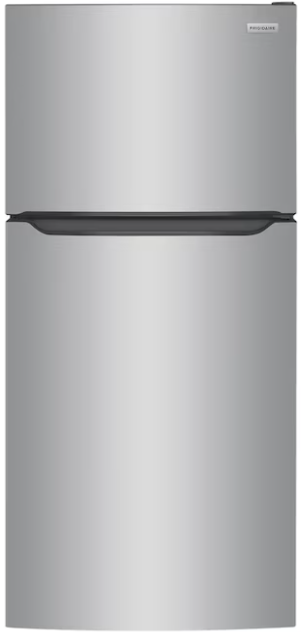
Frigidaire Top-Freezer
Temperature settings, storage guidance, and everyday operation for the Frigidaire 20 cu ft top-freezer refrigerator.
01
Temperature settings
The temperature is controlled by a dial inside the fresh food compartment, numbered 1 (warmest) through 7 (coldest).
Recommended settings
- Fresh food section: Setting 4 — approximately 37°F, which is the recommended safe temperature for refrigerated food.
- Freezer: Controlled by the same dial. At setting 4, the freezer maintains approximately 0°F.
Adjusting the temperature
Turn the dial one number higher if food does not seem cold enough, or one number lower if items inside the fresh food section are beginning to freeze. After any adjustment, allow 24 hours for the temperature to fully stabilize before making another change.
02
Fresh food compartment
Shelves
The wire shelves are adjustable. To reposition a shelf, tilt the front edge up slightly to lift it off the shelf supports, slide it out, and reset it at the desired height. This is useful for storing taller items like pitchers or bottles.
Door bins
The door holds condiments, beverages, and smaller containers. Avoid storing dairy or eggs in the door — temperatures there fluctuate more than on the interior shelves.
Interior light
The light turns on automatically when the door opens. If the interior is dark when the door is open, let us know.
Keeping temperature stable
Close the door fully after each use. A door left slightly ajar will cause the refrigerator to run continuously and may let food warm or cause frost buildup in the freezer.
03
Freezer compartment
The freezer is the upper section, accessed by the top door. It maintains approximately 0°F at the recommended setting.
Using the freezer
- Allow hot food to cool to room temperature before placing it in the freezer — adding hot items raises the internal temperature and stresses the compressor.
- Avoid overpacking. Air needs to circulate around items to keep them evenly frozen.
- Keep the freezer door closed as much as possible. Each time it opens, cold air escapes and frost can form on interior surfaces.
Frost
A thin layer of frost on the freezer walls or items is normal. If frost accumulates significantly — more than about a quarter inch — the freezer door seal may not be closing fully. Please let us know.
04
Crisper drawers
The two crisper drawers at the bottom of the fresh food section each have a humidity slide control on the front of the drawer.
High humidity — for vegetables
Slide the control toward the high end to keep moisture inside the drawer. Best for leafy greens, broccoli, carrots, and most vegetables.
Low humidity — for fruit
Slide the control toward the low end to allow moisture to escape. Best for apples, pears, and most whole fruits. Fruit releases ethylene gas, which can cause nearby vegetables to ripen or spoil faster — keeping fruit in its own drawer helps prevent this.
05
Garage-ready operation
This refrigerator is rated Garage Ready, meaning it is engineered to operate correctly across a wide range of ambient temperatures — from 0°F to 110°F.
Standard refrigerators can fail to maintain safe temperatures when the surrounding room becomes very cold, because the compressor relies on the ambient warmth to trigger cooling cycles. The Garage Ready design resolves this. No special adjustment is needed on your part — the refrigerator self-regulates regardless of how warm or cool the surrounding space is.
06
Troubleshooting
Food does not seem cold enough
Check that the dial is set to at least 4 and that the door seals are closing completely. Make sure vents inside the compartment are not blocked by food pushed too close to the back wall.
Items in the fresh food section are freezing
Turn the dial one number lower and allow 24 hours for the temperature to restabilize.
Frost building up in the freezer
Check that the freezer door closes fully and that nothing is preventing the seal from contacting the frame. A small amount of frost is normal; significant buildup should be reported to us.
Unusual sounds
Some sounds are normal — a steady hum from the compressor, the occasional click when a cooling cycle starts or stops, and water dripping sounds during automatic defrost cycles. Loud, persistent, or grinding sounds should be reported to us.
Water pooling under or around the refrigerator
A small amount of condensation is normal during humid weather. Larger puddles may indicate a clogged defrost drain. Please let us know so we can investigate.
Still having trouble?
Please contact us through the booking platform. We're happy to help.